
Practice democracy one story at a time.
Free civics lessons where students argue about Humpty Dumpty's wall instead of real politics. Fourteen lesson plans with slides for grades 6 to 12, and a K to 12 map that lines each grade up with New York, Connecticut and Rhode Island standards.
What it is
Practice the process, not the politics
Storybook County is a made-up county built from public domain stories. Students write bills about the Three Little Pigs' building code, debate Humpty Dumpty's wall and argue Wolf v. Storybook County on appeal. Everyone knows the stories, nobody owns them, and nobody votes along party lines on a fairy tale, so class time goes to the civic skill.
- Free for any school, YMCA, library or family.
- Every lesson as a PDF and as projectable slides with timers and teacher notes.
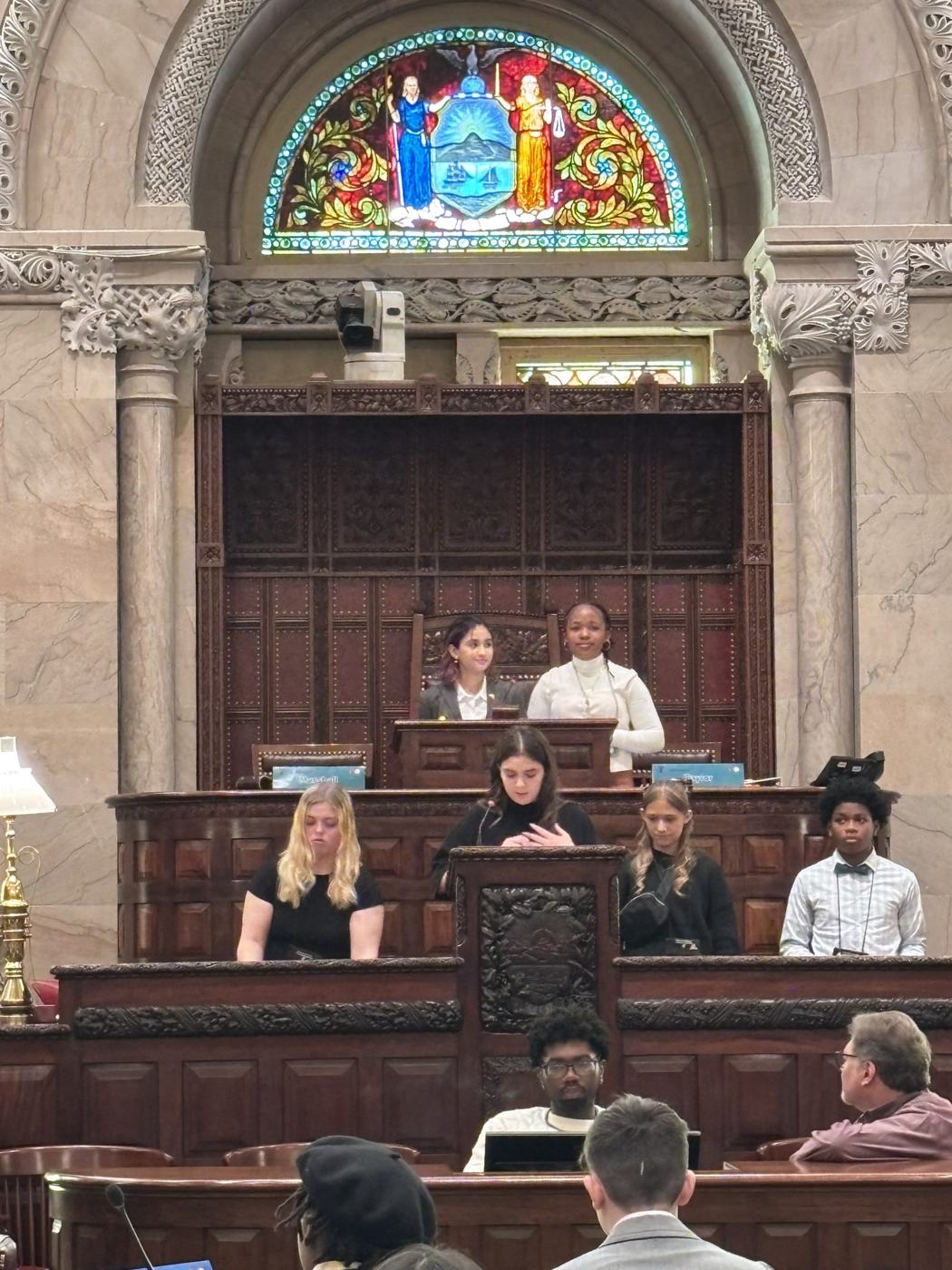
- Built on the same process students run at the YMCA Youth and Government conferences.
- Lined up with New York, Connecticut and Rhode Island social studies standards.
Start here
Three ways in
The lesson plans
14 lessons on public domain stories
Each lesson stands alone: three or four 30-minute sessions for grades 9 to 12, adaptable for middle school. Lesson 11 is written for grades 6 to 8.
Writing a Bill
An Act to Amend the Storybook County Building Code. Bill format, the original-law rule, underlining and strikeouts, and the Seal of State Approval checklist.
Committee Hearing and Bill Ranking
The hearing sequence, the Committee Chair's script, Clerk duties, the ranking rubric, and which bills advance.
Floor Debate and Parliamentary Procedure
The Humpty Dumpty Wall Safety Act. Recognition and decorum, motions, amendments, previous question, division and the vote.
Presiding Officer Training
Gavel signals, the chair's script, ruling on points of order, keeping time, and the Clerk and Sergeant at Arms roles.
The Governor's Cabinet and Veto Override
Cabinet bill review, the Comptroller's fiscal review, the signing meeting, veto messages and the two-thirds override.
The Governor's Theme and State of the State
Choosing a theme, drafting the Opening, State of the State and Closing speeches, and the Lieutenant Governor's service focus.
Running for Office and Elections
Candidate forms, the three-minute speech tied to a core value, press conference questions and voting.
Lobbyists and Youth Advocates
Representing an interest group, interviewing a sponsor, writing a one-page leave behind, and advocacy ethics.
The Press Corps
The Storybook Gazette: news writing, interviews, photo shot lists, the nightly broadcast, social posts and media literacy.
The Court of Appeals
Wolf v. Storybook County. The appellate brief, oral argument before a five-justice panel, and the written opinion.
Middle School Resolutions
Writing and presenting a resolution with a partner in a simplified debate format. Designed for grades 6 to 8.
Core Value Speeches
Short speeches on caring, honesty, respect and responsibility, delivered as a character, with peer feedback.
Service Learning and the Service Focus
Learning objectives, action, reflection and evaluation applied to a community need from a story.
Proposals and Roundtables (CONA)
Writing and presenting a proposal on a national-scale problem, then a roundtable reflection.
Unit plans
Put the lessons together
Legislative unit
Lessons 1 to 5: write bills, hear them in committee, debate them with student presiding officers, and send them to a student Governor and Cabinet.
Full model-government unit
Lessons 1 to 9, then a one-day classroom State Conference.
From charge to trial to appeal
The Literary Character Court in the Educator Toolkit, then Lesson 10, the Court of Appeals.
Speeches and service
Lessons 6, 7, 12, 13 and 14, with the Public Speaking Skill Builders.
K to 12 map
One Storybook County lesson for every grade
From the Three Bears' house rules in kindergarten to a real civics capstone in grade 12. Pick a grade to see the lesson, the tools, the state standards it meets, a note for your principal, and how to make it local.
A planning map. Grades 4 to 12 use the 14 lesson plans above, cut to fit. The kindergarten to grade 3 lessons are outlines for now and will be written out in the same format. Standards codes were checked against each state's published documents on Oct 7, 2026; confirm the current version with your district before citing them in a unit plan. Want to write one of these grades? Here is how.
Each grade has five parts
- The lesson: the Storybook County scenario and the YMCA Youth and Government process it practices, scaled to the grade.
- Tools: the handouts and free outside tools a teacher would use, named so they can be found.
- State goals it hits: the standard or framework code for New York, Connecticut and Rhode Island, quoted or paraphrased from the official document and linked in Sources.
- For educators: a plain explanation of why the activity meets those goals, so a teacher can defend it to a principal or curriculum office.
- Make it local: how to replace a Storybook County office with the real one in your town, county or state.
The ladder at a glance
Scroll sideways to see the whole table.
| Grade | Storybook County lesson | Youth and Government process | Strongest fit |
|---|---|---|---|
| K | The Three Bears Make House Rules | Making and voting on a rule | All three |
| 1 | Who Keeps Nursery Rhyme Village Running? | Leaders, helpers, a village meeting | All three |
| 2 | Fix the Park: The Village Election | Local services and an election | NY, CT |
| 3 | The Queen's Decree or the People's Law? | How a rule becomes a law | CT (bill to law), NY (comparing governments) |
| 4 | Junior Model Legislature | Bill, committee, floor vote, governor | NY, RI (state and local government) |
| 5 | The Storybook County Charter Convention | Writing a constitution | All three |
| 6 | Aesop's Assembly: Direct or Representative? | Direct vs representative democracy | NY, CT |
| 7 | The Veto and the Court: Checks in Storybook County | Veto, override, appeal | NY (Middle School Capstone) |
| 8 | The Storybook Compromise and Middle School Resolutions | Resolutions, elections, a student-led project | RI (project), NY (capstone), CT |
| 9 | Wonderland Empire or Storybook Republic? | Written law and the original-law rule | NY |
| 10 | The Storybook County Bill of Rights | Floor debate and appellate argument on rights | All three |
| 11 | Lobbyists, Parties and the Press | Advocacy, campaigns and the Press Corps | RI, CT, NY Seal |
| 12 | From Storybook County to Your County | The full conference, then a real Civics Capstone | All three seals and projects |
Every grade, in detail
KindergartenThe Three Bears Make House Rules
Students decide, as the Three Bears' neighbors, what rules a house needs after Goldilocks visits, then vote one rule into the classroom.
The lesson. Three 15 to 20 minute sessions. Session 1 retells the story and asks what went wrong for the Bears and for Goldilocks. Session 2 has small groups draw one rule for the Bears' house (knock first, ask before you eat) and explain who it keeps safe. Session 3 is the first Youth and Government vote: each group presents its rule, the class votes with a show of hands or colored cards, and the winning rule goes on the classroom wall with every student's handprint. The Youth and Government process is the simplest one there is: propose, explain, vote, follow.
Tools. Picture rule cards; a classroom ballot box or colored voting cards; the Kids section of Ben's Guide to the U.S. Government for a read-aloud on why we have rules; NYSED's Civic Readiness for All Students K-4 (opens in a new tab) for the domain language.
Scroll sideways to see the whole table.
| State | Goal | What it asks |
|---|---|---|
| NY | K.5, K.5c; K.4b; Practice F (K-4) | Rules affect children and adults; children have opportunities to contribute to rules; children can be responsible members of a classroom |
| CT | K.Civ.3.a; K.Civ.2.a; K.Inq.4.f | Explain the need for rules and laws; how all people contribute; use listening, consensus-building and voting to take action in the classroom |
| RI | SSK.2.2; SSK.2.3 | Analyze rules, roles and responsibilities at school; explain the responsibilities of classroom citizens |
For educators. The vote is the standard. New York's K.5c and Connecticut's K.Inq.4.f both ask for children to take part in making a rule, not only to follow one, and this lesson ends with a rule the class made and keeps. The "who does this rule protect" question in Session 2 is Rhode Island's SSK.2.2 analysis and New York's K.5b in kindergarten words.
Make it local. Swap the Bears' house for your own classroom or the school cafeteria, and invite the principal or a lunch monitor to hear the winning rule. In a YMCA program, use a real Y space (the gym, the pool deck) and present the rule to the program director.
Grade 1Who Keeps Nursery Rhyme Village Running?
Little Bo Peep has lost her sheep, and students hold a village meeting to decide who in Nursery Rhyme Village should help find them and what rule would stop it happening again.
The lesson. Three 20 minute sessions. Session 1 introduces the village's helpers and leaders on picture cards: the Village Leader, the Sheriff, the Shepherd, the Librarian (Old Mother Hubbard), and ordinary neighbors. Students sort them into "elected," "hired" and "neighbor who helps." Session 2 is the village meeting: Bo Peep explains the problem, each helper says what they can do, and the class talks through two possible rules (a fence, a sign-in sheet for the pasture). Session 3 is the vote, followed by each student drawing themselves as a good village citizen doing one of the traits on New York's list. Youth and Government process: a public meeting where a problem is heard before a decision.
Tools. Helper and leader picture cards; a "good citizen" trait chart; Ben's Guide for K-2 read-alouds on community leaders.
Scroll sideways to see the whole table.
| State | Goal | What it asks |
|---|---|---|
| NY | 1.3, 1.3b; 1.4b, 1.4c | A citizen is a member of a community; traits of a responsible citizen; governments exist at the local, state and national levels; children can take part in problem solving and decision making |
| CT | 1.Civ.12.a; 1.Inq.4.f | Identify and explain the role of rules in the community; use listening, consensus-building and voting to take action |
| RI | SS1.4.1; SS1.4.2; SS1.4.4 | Rights and responsibilities of a citizen of a community; who community leaders are, elected and non-elected; how to resolve problems |
For educators. The sorting activity is Rhode Island's SS1.4.2 almost word for word (elected and non-elected leaders), and the village meeting is New York's 1.4c (problem solving and decision making in the community). The trait drawing gives you an assessment of 1.3b without a worksheet.
Make it local. Replace the village helpers with your community's real ones: your mayor, town supervisor or first selectman, the school resource officer, the librarian. Rhode Island and Connecticut teachers can use the town council president or first selectman; New York teachers in villages can use the village mayor. A real photo of each person on the card is what makes the "names and faces" stick.
Grade 2Fix the Park, The Village Election
The swings in Nursery Rhyme Village Park are broken, the library wants new books and the road to the Riverbank has potholes, and the village can only pay for one this year, so two candidates for Village Leader campaign on which to fix first.
The lesson. Three 20 to 25 minute sessions. Session 1 lists what the village government does (parks, roads, library, trash pickup, safety) and who is in charge of each. Session 2 splits the class behind two candidates (the Tortoise for roads, Mother Goose for the library); each side makes a poster and a one-minute speech, and students hear the other side's reasons. Session 3 is Election Day with a secret paper ballot, a count by student "poll workers," and the winner's first decision. Youth and Government process: candidate speeches and the General Election, scaled down.
Tools. Paper ballots and a ballot box; a "what does our village do?" services chart; Ben's Guide on elections.
Scroll sideways to see the whole table.
| State | Goal | What it asks |
|---|---|---|
| NY | 2.3c; 2.4, 2.4b, 2.4c | Elections and voting are democracy in action; communities have leaders who make and enforce laws; citizens serve their community |
| CT | 2.Civ.1.a; 2.Civ.5.a; 2.Civ.10.a | Roles of local officials (mayor, selectman); the role of local government (public safety, roads, libraries); compare one's own view of a community issue with others' |
| RI | SS2.4.3; SS2.4.5 | Rules and responsibilities governments and individuals have to each other; ways students can contribute to positive change |
For educators. Connecticut's grade 2 standards are almost this exact lesson: 2.Civ.5.a lists public safety, roads and libraries as local government's job, and 2.Civ.10.a's example is "differing opinions on park improvements." New York's 2.3c names voting as democracy in action. Rhode Island's grade 2 year is global communities, so here the lesson serves SS2.4.3 and SS2.4.5 rather than a local-government standard; say so in your unit plan.
Make it local. Use a real choice your town faced: a playground, a library budget, a sidewalk. Your town's budget page or a local news story gives the real numbers. If your town or village election is coming, time Election Day to match it.
Grade 3The Queen's Decree or the People's Law?
In Wonderland, the Queen of Hearts makes a rule by shouting it; in Storybook County, a rule has to pass the Legislature and be signed by the Governor. Students run the same idea, "no croquet on Tuesdays," through both and decide which way is fairer.
The lesson. Three 25 minute sessions. Session 1 acts out the Queen's decree (one person decides, nobody votes, no one can appeal). Session 2 runs the idea through Storybook County as a five-step bill: a student writes it, a committee of five hears it, the class votes, the Governor signs or vetoes, and it becomes law. Session 3 compares the two on a T-chart (who decides, who gets a say, what happens if you disagree) and connects Storybook County to the real state: who is our Governor, and what is our legislature called? Youth and Government process: how a bill becomes a law, in five steps.
Tools. A one-page bill frame; a five-step "bill to law" track on the floor; the T-chart; Ben's Guide on how laws are made; the legislature's own bill process page for your state.
Scroll sideways to see the whole table.
| State | Goal | What it asks |
|---|---|---|
| NY | 3.7, 3.7a, 3.7b, 3.7d | Governments have authority to make and enforce laws; selecting leaders and making decisions differs across governments; the citizen's role varies |
| CT | 3.Civ.4.b; 3.Civ.1.a; 3.Inq.4.f | Explain how a bill becomes a law in Connecticut; powers of state and local officials; use deliberative and democratic procedures in the classroom |
| RI | SS3.1.4 | Analyze components of the United States government ("What are rules and laws?") |
For educators. New York's grade 3 year compares communities around the world, and 3.7b asks how selecting leaders and making decisions differ across governments: Wonderland and Storybook County are two governments to compare. Connecticut's 3.Civ.4.b asks students to explain how a bill becomes a law in Connecticut, which Session 2 rehearses before you show the real version. In Connecticut this lesson can also count toward the required grades 3-5 democracy program on all branches of government (C.G.S. 10-18); add the Governor's veto and a judge's ruling to cover all three.
Make it local. Show a real bill your state passed that students would care about (a state symbol, a school safety rule) and trace it through the same five steps on the legislature's website.
Grade 4Junior Model Legislature
This is the grade where New York and Rhode Island both teach state and local government, so students run a full, short Storybook County legislature and then find their own real legislators.
The lesson. Four 30 minute sessions. Session 1: the class becomes the Storybook County Legislature, two chambers with a Speaker, and each pair of students writes a one-page bill on a story problem (Humpty Dumpty's wall, Jack's beanstalk permit, the Three Pigs' building code). Session 2: committee hearings, where the author explains, classmates ask questions, and the committee picks bills to advance. Session 3: floor debate with a student Speaker and a vote, then the Governor signs or vetoes. Session 4: "Who is ours?" Students look up their real governor, state senator and assemblymember or representative, and learn whether they live in a county, city, town or village. Youth and Government process: the whole legislative cycle in miniature, the same one high schoolers run at the State Capitol.
Tools. Storybook County Lesson Plans 1 to 3 (Writing a Bill, Committee Hearing, Floor Debate), cut to 30 minutes each; your state's find-your-legislator tool on the legislature's website; iCivics games on lawmaking for early finishers (check the grade level on each).
Scroll sideways to see the whole table.
| State | Goal | What it asks |
|---|---|---|
| NY | 4.4, 4.4b, 4.4c, 4.4e | Levels of government; identify the governor, local senator and assemblyperson; the steps for a bill to become law in New York; government organized into counties, cities, towns and villages; citizens' responsibilities |
| CT | 4.Civ.12.a; 4.Inq.4.f; C.G.S. 10-18 democracy program | How people work to change laws; deliberative procedures to address problems; the required grades 3-5 program on all branches |
| RI | SS4.6.1; SS4.6.2; SS4.6.4 | Rhode Island state government, rules and laws ("How are state laws made?"); local city or town government; how children can take part in state and local government |
For educators. New York's 4.4b content specification asks students to "investigate the steps necessary for a bill to become a law in New York State" and to name the governor, local senator and assemblyperson; Sessions 1 to 4 do exactly that, in that order. Rhode Island's SS4.6.4 guiding question, "How can children participate in their state and local governments?", is answered by the session where students find their own legislators and write them about their Storybook bill's real-world version. In Connecticut, grade 4 is United States geography, so frame this as the grades 3-5 democracy program.
Make it local. Swap the Storybook Legislature for your state's: New York's Assembly has 150 members and Senate 63; Connecticut's House 151 and Senate 36; Rhode Island's House 75 and Senate 38. A student letter to the real legislator, with the Storybook bill attached, is the strongest ending. Invite the legislator or district office staff to hear the bills.
Ready-made slides for this grade
Grade 5The Storybook County Charter Convention
Storybook County has never had a written charter, and every district (Nursery Rhyme Village, the Deep Woods, Beanstalk Hollow, Wonderland, the Riverbank) sends delegates to write one, the same way the states sent delegates to write the Constitution.
The lesson. Four 30 minute sessions. Session 1: each district lists what it wants and fears (the Deep Woods fears a law against wolves; Wonderland wants a strong leader; the Riverbank wants roads). Session 2: delegates decide the shape of government: one leader or three branches, one chamber or two, how leaders are chosen. Session 3: a short Bill of Rights, three to five rights every character keeps no matter who wins. Session 4: the signing, plus a comparison of the class charter to the U.S. Constitution and the state constitution. Youth and Government process: delegations negotiating as equals, the core of every conference.
Tools. District delegate cards; a charter template (preamble, branches, rights, how to amend); National Archives DocsTeach for the Constitution and Declaration; the Center for Civic Education's We the People elementary materials.
Scroll sideways to see the whole table.
| State | Goal | What it asks |
|---|---|---|
| NY | 5.6, 5.6a, 5.6b | Political systems vary in structure; founding documents define the values and principles of constitutional democracy |
| CT | 5.Civ.5.a; 5.Civ.4.a; 5.Civ.14.a | The Constitution's role (federalism, separation of powers); colonial political systems (town meetings, tribal councils, juries); how individuals and groups effect change |
| RI | SS5.3.4; SS5.3.2 | Analyze the elements of the Constitution and its significance in forming the nation; the ideals of the Declaration of Independence |
For educators. Students do not memorize the Constitution here; they rebuild its reasoning, which is what Connecticut's 5.Civ.5.a and Rhode Island's SS5.3.4 ask ("analyze," "explain the role"). New York's grade 5 year is the Western Hemisphere, and 5.6b's "founding documents define the values, beliefs, and principles of constitutional democracy" is met when students compare their charter to the real Constitution. Connecticut teachers can add a Session 2 option for a town-meeting district (5.Civ.4.a) and use the whole lesson for the grades 3-5 democracy program.
Make it local. Bring in your own local charter. Many New York cities and counties and 113 of Connecticut's 169 towns have one, and every Rhode Island city and town has home rule under Article XIII of the state constitution. A page of the real charter next to the class charter shows students that this is how their own town was built.
Grade 6Aesop's Assembly, Direct or Representative?
Aesop's fables are ancient Greek, so the animals of the fables hold an Athenian-style assembly where every citizen votes on every question, then try the same question in the Storybook County Legislature, where districts send representatives.
The lesson. Three 30 minute sessions. Session 1: the Fable Assembly. Every student is a citizen (the Ant, the Grasshopper, the Tortoise, the Hare, the Lion, the Mouse) and the whole class debates and votes on "Should the grain stores be shared in winter?" Session 2: the same question in the Storybook County Legislature, where four districts each elect one representative, and those four decide after hearing their districts. Session 3: compare. Which was faster? Which heard more voices? Who was left out (in Athens, women, enslaved people and foreigners could not vote)? Close with the Middle School Resolutions lesson's resolution format, so students write their first resolution on the grain question. Youth and Government process: chamber debate and the resolution.
Tools. Fable character cards; a comparison chart (direct, representative, Storybook County, your town); Kialo Edu to map the grain-store argument; Storybook County Lesson 11, Middle School Resolutions.
Scroll sideways to see the whole table.
| State | Goal | What it asks |
|---|---|---|
| NY | 6.5, 6.5b; Practice F (5-8) | Political structures developed to establish order, create and enforce laws and enable decision making (Athens, Rome compared); participate in persuading, negotiating and compromising |
| CT | 6.Civ.14.a; 6.Inq.4.f | Compare how individuals and groups have affected change; assess individual and collective capacities to take action |
| RI | SS6.4.1 (connection only) | Impacts of major empires; guiding question "What methods of government did leaders of empires develop?" |
For educators. New York's 6.5b names Athens and the Roman Republic by name as political systems to compare, and this lesson puts students inside one. Rhode Island's grade 6 standards have no civics-focused standard, so in Rhode Island present this as a world history lesson with a civics connection, not as a standards match. In all three states, the Session 1 vote is a Practice F or Inq.4.f action indicator in its simplest form.
Make it local. Connecticut has a living example of direct democracy: many towns still govern by town meeting, where every voter can speak and vote on the budget. Some Rhode Island towns hold a financial town meeting. New York students can compare to a village or school budget vote. Show a real town meeting warning or agenda in Session 3.
Ready-made slides for this grade
Grade 7The Veto and the Court, Checks in Storybook County
The Storybook Legislature passes the Porridge Act, the Governor vetoes it, the Legislature tries to override, and when it finally becomes law the Three Bears take it to court, so students watch all three branches check each other on one bill.
The lesson. Four 30 minute sessions. Session 1: a short floor debate and vote on the Porridge Act (a two-crown fee on porridge sold at the market). Session 2: the Governor's Cabinet reviews it and the Governor writes a veto message; the Legislature needs two-thirds to override. Session 3: the override passes, and the Three Bears sue, arguing the Act violates the county charter; a five-justice panel hears two-minute arguments. Session 4: a one-page "federalism map" of which level of government (county, state, federal) would really handle porridge, roads, schools and the army, then the first step of a Middle School Capstone: pick a real issue and name which level of government owns it. Youth and Government process: the Governor's Cabinet and veto override, and the Court of Appeals.
Tools. Storybook County Lesson 5 (Governor's Cabinet and Veto Override) and Lesson 10 (Court of Appeals), each cut to one session; iCivics games on the branches and on rights; the Civic Seal Unit 7 planner for the capstone start.
Scroll sideways to see the whole table.
| State | Goal | What it asks |
|---|---|---|
| NY | 7.5, 7.5a, 7.5b; Practice F (grade 7, item 9); Seal 2d Middle School Capstone | Federalism shares power among federal, state and local governments; three branches and checks and balances; engage in the political process in a local context; capstone open to grades 7 and 8 (1 point) |
| CT | 7.Civ.2.a; 7.Inq.4.f | How political participation varies across governments; assess capacities to take action using a range of levers of power |
| RI | Civic Literacy Act project (may start in middle school) | Grade 7 standards are world history (SS7.4.1 political revolutions); civics fits through the student-led project |
For educators. New York's 7.5b asks for the three branches and "a system of checks and balances," and students run each check themselves: veto, override, judicial review. The federalism map in Session 4 is 7.5a. Grade 7 is the first year a New York student can earn a Seal of Civic Readiness point through the Middle School Capstone, so Session 4 is written as that project's first step. In Rhode Island and Connecticut, grade 7 is world history; present this as the civics bridge and, in Rhode Island, as a possible start to the required student-led civics project.
Make it local. Replace the Porridge Act with a real local fight that went through more than one branch: a mayor's or county executive's veto, a zoning appeal, a court ruling on a town decision. Your local newspaper's archive is the source.
Ready-made slides for this grade
Grade 8The Storybook Compromise and Middle School Resolutions
Grade 8 is the strongest middle school civics year in all three states, so this entry is a full unit: students reenact a Storybook version of the Connecticut Compromise, then run a Middle School Model Youth Legislature and finish with a student-led civics project on a real issue.
The lesson. Six 30 minute sessions. Sessions 1 and 2, the Storybook Compromise: big districts (Wonderland, the Deep Woods) want seats by population and small ones (Sleepy Hollow, the Riverbank) want equal seats, and students negotiate until they invent two chambers. Sessions 3 and 4: Middle School Resolutions, written with a partner and debated in the simplified format the New York Middle School conference uses. Session 5: a Storybook election with candidate speeches tied to a core value. Session 6: launch the student-led civics project (Civic Seal Unit 7): each pair picks a real school or community issue and writes the resolution they will take to a real audience. Youth and Government process: the Middle School Model Youth Legislature, start to finish.
Tools. Storybook County Lesson 11 (Middle School Resolutions) and Lesson 7 (Running for Office); Civic Seal Unit 7, The Student-Led Civics Project; RIDE's Civics Project Planning Template and Civic Action Project Rubrics, linked from the RIDE social studies page.
Scroll sideways to see the whole table.
| State | Goal | What it asks |
|---|---|---|
| NY | 8.9; Practice F (5-8); Seal 2d Middle School Capstone | Civil rights and reform as efforts to address problems; fulfill responsibilities by engaging in the political process; the capstone (identify an issue, apply civic knowledge, reflect, present), 1 point |
| CT | 8.Civ.10.a; 8.Civ.4.a; 8.Civ.8.a; 8.Inq.4.f | Perspectives debated at the Constitutional Convention (the Connecticut Compromise is the named example); powers and limits of the branches; the Bill of Rights; take action in out-of-school civic contexts |
| RI | SS8.6.2; SS8.6.3; SS8.3.4; SS8.4.2; Civic Literacy Act | Responsibilities of a citizen; elections and how to get involved; checks on power; Rhode Island state government; the student-led civics project, which RIDE says this course is an opportunity to deliver |
For educators. Rhode Island's grade 8 course is titled Government and Civic Life in the United States and Rhode Island, and RIDE names it as an opportunity to carry out the civics project the Civic Literacy Act requires; Session 6 meets the statute's two tests (reason from evidence; connect federal, state and local policy to the community). Connecticut's 8.Civ.10.a uses the Connecticut Compromise as its own example. In New York, Session 6 is the Middle School Capstone, worth 1 Seal point, and delegates who go on to the Middle School conference in Albany bring a finished resolution.
Make it local. Use your town's own representation question: how many council or board members, elected at large or by district, and whether that is fair. The real audience for Session 6 can be the principal, the school board, the town council or a Youth and Government conference committee.
Ready-made slides for this grade
Grade 9Wonderland Empire or Storybook Republic?
The Queen of Hearts rules Wonderland by decree and expands by conquest; Storybook County governs by written law that anyone can read. Students compare the two systems the way the Global History course compares classical empires, then write their first real-format bill.
The lesson. Four 30 minute sessions. Session 1: the Queen's decrees are posted with no record, no hearing and no appeal; students list what that does to ordinary people. Session 2: students study a short written law code (the Storybook County Building Code from Lesson 1) and find what a written law gives that a decree does not: notice, consistency, a way to change it. Session 3: each student writes an amendment to the Building Code using the Youth and Government bill format and the original-law rule (show the old text struck out, the new text underlined). Session 4: committee hearings and the bill ranking rubric. Youth and Government process: Writing a Bill and Committee Hearing, at full conference standard.
Tools. Storybook County Lessons 1 and 2; the Seal of State Approval checklist; Media Literacy Lesson 1 (Who Said That?) as a companion for primary-source reading.
Scroll sideways to see the whole table.
| State | Goal | What it asks |
|---|---|---|
| NY | 9.3, 9.3b; Practice F (9-12) | Empires used systems of law and forms of government to consolidate power; respectfully disagree and provide evidence for a counter-argument |
| CT | CG.Civ.4.b; CG.Inq.4.f (Civics and Government course, any high school grade) | How a constitution organizes and divides power to create limited government; evaluate and implement strategies for action |
| RI | SSHS.CVC.4.2 (High School Civics, no grade assigned) | Structure and role of the legislative branch |
For educators. New York's 9.3b says empires used "systems of law, forms of government, military forces, and social hierarchies to consolidate and expand power," and the Wonderland half of this lesson is that idea in one scene. The bill-writing half is preparation for the conference and the Seal: a student who writes a full bill now has the skills for the High School Civics Project in grade 10 or 11. Connecticut and Rhode Island assign their high school civics course to no fixed grade, so use this lesson in whichever year your school offers it.
Make it local. For the bill, swap the Building Code for a real local ordinance students can find online: a noise rule, a skate park rule, a curfew. Code libraries for many New York, Connecticut and Rhode Island municipalities are posted on the town or city website.
Ready-made slides for this grade
Grade 10The Storybook County Bill of Rights
After the Wolf is convicted at trial, students argue on appeal whether Storybook County gave him the rights every resident is owed, then debate adding those rights to the county charter in the Legislature.
The lesson. Five 30 minute sessions. Session 1: the Enlightenment in Storybook terms. Who agreed to be governed, and what did they keep? Students draft a social contract for the county. Session 2: Wolf v. Storybook County, briefs in teams (was the confession obtained fairly; was the jury drawn from the Deep Woods at all?). Session 3: oral argument before a five-justice panel. Session 4: floor debate on a charter amendment adding the rights the court discussed. Session 5: compare the class amendment to the Universal Declaration of Human Rights and to the state constitution's rights article. Youth and Government process: Court of Appeals and Floor Debate.
Tools. Storybook County Lessons 3 (Floor Debate) and 10 (Court of Appeals); Media Literacy Lesson 3 (The Wolf's Side) for the framing and missing-voices angle on the same case; the UDHR text.
Scroll sideways to see the whole table.
| State | Goal | What it asks |
|---|---|---|
| NY | 10.2, 10.2a; 10.10 | Enlightenment political philosophies: social contract, consent of the governed, rights of citizens; human rights principles as a lens on oppression |
| CT | CG.Civ.4.b; CG.Inq.4.f | Constitutional limits on power; strategies for action |
| RI | SSHS.CVC.1.3 | How different definitions of citizenship and how to act as a citizen have affected different people |
For educators. New York's 10.2a lists "social contract, consent of the governed, and the rights of citizens," and Sessions 1 to 4 have students write, argue and amend each one. The appellate brief and argument also build the evidence-based reasoning Rhode Island's Civic Literacy Act names, and the full sequence is strong preparation for a High School Civics Project (Civic Seal Unit 2 or 3) in New York.
Make it local. Read the rights article of your own state constitution in Session 5: New York's Article I, Connecticut's Article First, Rhode Island's Article I. Invite a public defender, prosecutor or appellate judge to sit on the Session 3 panel; Youth and Government judicial volunteers already do this at conference.
Ready-made slides for this grade
Grade 11Lobbyists, Parties and the Press
The Riverbank Motorcar Act is moving, and every group with a stake shows up: the Riverbank Motor Company's lobbyist, the Woodland Residents Association, two Storybook parties, and the Gazette, so students see how a bill is shaped from outside the chamber.
The lesson. Five 30 minute sessions. Session 1: map the interests (who gains, who pays, who is not in the room). Session 2: lobbyists and youth advocates interview the sponsor and write a one-page leave behind. Session 3: two parties write platforms on road funding and run a short campaign; the Press Corps covers both. Session 4: the floor vote, with lobbyists in the gallery and reporters filing stories. Session 5: debrief using the disclosure rule from Media Literacy Lesson 5: who paid for each message students saw this week? Youth and Government process: Lobbyists and Youth Advocates, Elections, and the Press Corps.
Tools. Storybook County Lessons 7, 8 and 9; Media Literacy Lessons 2 and 5; Civic Seal Unit 2 (Policy Advocacy Through a Bill) or Unit 5 (Legislative Research Project) to carry the work into a Seal project.
Scroll sideways to see the whole table.
| State | Goal | What it asks |
|---|---|---|
| NY | 11.10; Seal 1e Research Project or 2a High School Civics Project | Inequalities addressed by individuals, groups and organizations, and debates over government's role; Research Project 1 point, High School Civics Project 1.5 points (up to twice) |
| CT | CG.Civ.8.a; CG.Inq.4.f | How state and local structures promote public participation (boards of education, the General Assembly, municipal government); strategies for collective action |
| RI | SSHS.CVC.5.4; Civic Literacy Act | Impacts people can have on the political system through parties, interest groups and politics; the student-led civics project |
For educators. Rhode Island's SSHS.CVC.5.4 names parties and interest groups as ways people affect the political system, and students play both. New York's 11.10 asks how individuals, groups and organizations addressed inequality and debated the government's role, which is the content of every leave behind and platform here. Teachers who want Seal credit should assign Civic Seal Unit 2 or 5 alongside so the work is documented.
Make it local. Use a real bill in your state legislature this session and real registered lobbying groups; New York, Connecticut and Rhode Island each publish lobbyist registrations. A local reporter as a guest for Session 3 makes the Press Corps real.
Ready-made slides for this grade
Grade 12From Storybook County to Your County
Seniors run the whole Storybook County conference in two weeks, then spend the rest of the unit doing the same work on a real issue in their own community, which is the project all three states now reward.
The lesson. Two parts. Part 1, the classroom State Conference (about eight 30 minute sessions): bills from Lesson 1 go through committee, floor debate with student presiding officers, the Governor's Cabinet and signing, and an election, with the Press Corps covering it. Part 2, the real project (four to six weeks): each student or team picks a local issue, researches the original law, meets or writes the official responsible, and presents a bill or resolution to a real audience, documented with the Civic Seal Unit 1 forms. Youth and Government process: the full conference, then the Civics Capstone.
Tools. Storybook County Lessons 1 to 9 and 14; Civic Seal Units 1 (Civics Capstone), 4 (Service Focus) and 6 (Youth and Government Portfolio); Media Literacy Lesson 6 (The Storybook County Media Corps) for the community interview.
Scroll sideways to see the whole table.
| State | Goal | What it asks |
|---|---|---|
| NY | 12.G1 to 12.G5, especially 12.G4e and 12.G5; Seal 2f Civics Capstone | Participation in Government: foundations, rights, citizenship, participation (contacting officials, petitions, advocacy), public policy at every level; Civics Capstone 4 points |
| CT | CG.Civ.2.a; CG.Civ.8.a; CG.Inq.4.f; State Seal of Civics Education and Engagement (PA 26-1) | State and local governments as models of democracy; how they invite participation; implement strategies for action; the Seal's civic engagement project and portfolio |
| RI | SSHS.CVC.4.5; Civic Literacy Act | State, local and tribal governments and how they interact with the federal government; the student-led civics project and civics proficiency |
For educators. New York's Participation in Government course deliberately has no content specifications so it "can adapt to present local, national, and global circumstances," which is the invitation this unit accepts. Part 2 meets the New York Civics Capstone (4 of the 6 Seal points), the Rhode Island project definition (evidence-based reasoning; connecting federal, state and local policy to the community), and the Connecticut Seal's civic engagement project. Connecticut districts set their own Seal criteria; bring this map to the district's Seal coordinator before the year starts.
Make it local. Part 2 is local by design. The swap table in the next section turns every Storybook County office into its real counterpart in your town, county and state.
Ready-made slides for this grade
Remix the stories
Why public domain characters, and how students remix them
Every Storybook County character comes from the public domain on purpose. Nobody owns them, so any school, YMCA, library or family can use, adapt and retell them without permission or licensing fees. Most students already know the stories, so time goes to the civic skill instead of the plot. And nobody votes along party lines on Humpty Dumpty's wall, so students can argue hard about policy without arguing about real people.
The fairy tales are the starting point, not the finish line. Ask students which characters from their own lives (books, shows, games, sports, the news, your town) would make the lesson sharper, then let them improve it. Explaining why one character fits a civic role better than another, and rebuilding a lesson so it lands for classmates, is its own level of critical thinking: students have to understand the skill well enough to teach it.
Remix in four steps.
- Name the skill. The class states in one sentence what the lesson teaches.
- Pitch a swap. Students propose a new character, story or local issue and say why it fits better.
- Test it. Does it still teach the same skill? Does everyone know the story? Could it hurt or single out anyone? Would it turn a lesson about process into a fight about real politics?
- Run it and reflect. Teach the remix, or one session of it, and ask which version worked better and why.
Scroll sideways to see the whole table.
| Grades | What a remix looks like |
|---|---|
| K to 2 | The teacher leads. Students suggest a character from a favorite picture book or class read-aloud and say which rule that character would want. The class votes on the swap. |
| 3 to 5 | Pairs pick a character from a book, show or game and explain in two sentences why it fits the role better. The class asks: does it still teach the same thing? |
| 6 to 8 | Small groups rewrite one scenario or handout around their character or a school issue, then teach it to another group, who judge whether the skill still comes through. |
| 9 to 12 | Students redesign a full session for their peers or a younger grade, name the standard it meets, and defend their changes the way a sponsor defends a bill in committee. |
Guardrails. Characters from current movies, shows, games and books belong to someone, so keep remixes that use them inside the classroom; do not print, post or share them. Public domain and original characters can go anywhere. Use public figures only for their public actions; never use classmates, school staff or private local people as characters. If a swap brings in a current officeholder or a live issue, use chamber rules: argue the policy, never the person, and give both sides equal time.
State standards
The three states' civics goals at a glance
All three states build civics in steps, peak in grade 4 (state and local government), grade 8 and a high school government course, and now reward students for a documented civic action project. That shared shape is why one Storybook County ladder can serve all three.
Scroll sideways to see the whole table.
| Topic | New York | Connecticut | Rhode Island |
|---|---|---|---|
| Standards in force | K-8 Social Studies Framework (opens in a new tab) and 9-12 Framework with 2017 updates (opens in a new tab) | Connecticut Elementary and Secondary Social Studies Standards (opens in a new tab), adopted October 4, 2023, replacing the 2015 Frameworks | Rhode Island Social Studies Standards, endorsed February 2023, full use required by 2026-27 |
| Code format | Key Idea, e.g. 4.4, 12.G4 | Grade.Civ.number, e.g. 3.Civ.4.b; action indicators Grade.Inq.4.f | SS + grade + topic, e.g. SS4.6.1; high school SSHS.CVC.4.5 |
| Civic action thread, every grade | Social Studies Practice F, Civic Participation | Inq.4.f, taking informed action | Civic Learning Practices in the Civic Learning Guidebook (opens in a new tab), including simulations |
| Peak civics years | Grade 4 (NY state and local government), grades 7-8, grade 12 Participation in Government | Grades 2-3 (local and CT government), grade 8, high school Civics and Government | Grade 4 (RI state and local government), grade 8 Government and Civic Life, high school Civics |
| Elementary requirement | NYSED Civic Readiness for All Students K-4 (opens in a new tab) | A participatory democracy program covering all branches in grade 3, 4 or 5 (C.G.S. 10-18) | None separate; grade 4 standards cover it |
| Seal or project | Seal of Civic Readiness (opens in a new tab): 6 points, at least 2 Civic Knowledge and 2 Civic Participation; Middle School Capstone (grades 7-8) 1 point; Civics Capstone 4 points | State Seal of Civics Education and Engagement (opens in a new tab) (PA 26-1): district opt-in, class of 2027 onward, criteria include a civic engagement project | Civic Literacy Act (R.I.G.L. 16-22-2): civics proficiency, and at least one student-led civics project in middle or high school |
Make it local
Swap Storybook County for your town
Keep the story problem and swap the office: every Storybook County role has a real counterpart, and the biggest difference among the three states is that New York has county government and Connecticut and Rhode Island do not.
Scroll sideways to see the whole table.
| Storybook County | New York | Connecticut | Rhode Island |
|---|---|---|---|
| County government | 57 counties outside New York City; charter counties may have a county executive or manager; legislature is a county legislature or board of supervisors | None since October 1, 1960; 9 planning regions, each with a council of governments of local mayors and first selectmen | None; 39 cities and towns hold local power |
| Village Leader or Mayor | City mayor (62 cities), town supervisor (933 towns), village mayor (532 villages) | Mayor, first selectman, or appointed town manager (33 towns) | Mayor, or appointed town administrator or manager |
| Village Council | City council; town board; village board of trustees (mayor and four trustees by default) | Board of selectmen with town meeting, representative town meeting, or town council; optional board of finance | City or town council; some towns also hold a financial town meeting (for example Glocester, Jamestown, Tiverton) |
| Records Office and Clerk | Town, village, city or county clerk | Town clerk | City or town clerk |
| Storybook School Board | Board of education (689 school districts); New York City's Panel for Educational Policy | Local or regional board of education | School committee |
| Storybook Legislature | Assembly 150, Senate 63 | House 151, Senate 36 | House 75, Senate 38 |
| Governor | Governor | Governor | Governor and an elected Lieutenant Governor |
| Court of Appeals | Court of Appeals, the highest court: a Chief Judge and six Associate Judges | Supreme Court, Appellate Court and Superior Court; 54 elected probate districts | Supreme Court, with final appellate jurisdiction |
Three habits make any grade's lesson local:
- Use the real record. Real meeting minutes, a real ordinance or a real bill replace the Records Office handouts. All three legislatures and most towns post them online.
- Put a name and face on each office. Students should finish knowing who holds the office in their town, not only what the office does. A photo and a name on the role card does this.
- Invite the office in. A town clerk, council member, district office staffer or judge for one session turns a simulation into a relationship, which is the point of Youth and Government.
Counts are from the NYS Comptroller, the NYS Local Government Handbook (opens in a new tab), the Connecticut Register and Manual, OLR report 2020-R-0332 (opens in a new tab), the Connecticut General Assembly and the Rhode Island Constitution. New York village counts change as villages dissolve; check the Comptroller's map for the current number.
Tools and sources
What you need, and where the standards come from
Most of what each grade needs already exists in the Educator Toolkit; the outside tools below fill the gaps.
Scroll sideways to see the whole table.
| Tool | Grades | Used in |
|---|---|---|
| Storybook County Lesson Plans 1 to 14 | 4 to 12 (cut down for 4 to 8) | Grades 4, 6 to 12 |
| Storybook County Media Literacy Lessons 1 to 6 | 9 to 12, with middle school versions | Grades 9 to 12 |
| Civic Seal Units 1 to 7 | 7 to 12 | Grades 7, 8, 11, 12 |
| Ben's Guide to the U.S. Government | K to 5 | Grades K to 3 |
| iCivics games and lessons | Upper elementary to 12 (check each) | Grades 4, 7 |
| National Archives DocsTeach | 4 to 12 | Grade 5 |
| Center for Civic Education: We the People, Project Citizen | Elementary to 12 | Grades 5, 8 |
| Kialo Edu | 6 to 12 | Grade 6 |
| RIDE Civics Project Planning Template and Rubrics | 6 to 12 | Grade 8 (any state) |
Official standards and law opened for this map:
- New York: K-8 Social Studies Framework (opens in a new tab); 9-12 Framework with 2017 updates (opens in a new tab); K-12 Framework introduction (opens in a new tab); Seal of Civic Readiness Manual, updated March 2025 (opens in a new tab); Civic Readiness Initiative; Civic Readiness for All Students K-4 (opens in a new tab).
- Connecticut: Elementary and Secondary Social Studies Standards (2023) (opens in a new tab); State Board adoption, October 4, 2023 (opens in a new tab); C.G.S. Chapter 164, including 10-16b and 10-18; C.G.S. 10-221a graduation requirements; Public Act 26-1, State Seal of Civics Education and Engagement (opens in a new tab).
- Rhode Island: Social Studies Standards page; Anchor Standards (opens in a new tab); Grade progressions (opens in a new tab); Grade 4 (opens in a new tab); Grade 8 (opens in a new tab); High School Civics (opens in a new tab); R.I.G.L. 16-22-2, Civic Literacy Act; Civic Learning Guidebook (opens in a new tab); Middle School Secondary Regulations Guidance (opens in a new tab).

Help build Storybook County
Tell us how a lesson went, fix what didn't work, or write the next grade. Every note makes it better for young people.
For a better us.®